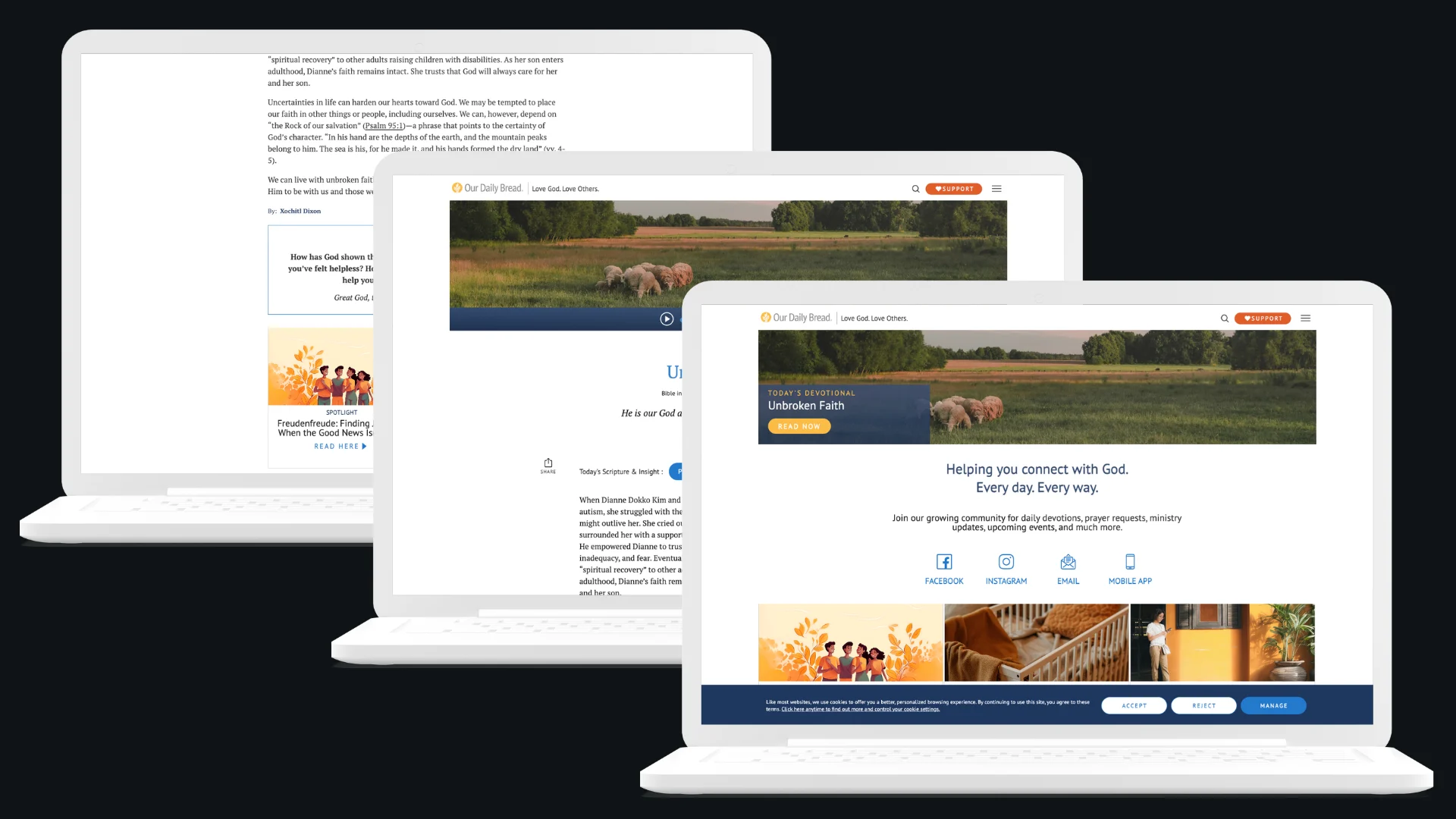
Our Daily Bread Ministries
GrapesJSTinyMCEWidget BuilderRTLCMSAndroid

Our Daily Bread Ministries

Helped launch a drag-and-drop widget builder for Our Daily Bread Ministries, a global Bible-teaching nonprofit publishing devotional content in many languages. Built the GrapesJS-based editor plus a TinyMCE content widget with live same-page preview and full right-to-left support for RTL-language regions, and tested feature delivery across Android devices.

Tech used

GrapesJSTinyMCEJavaScriptTypeScriptREST API

Situation

Our Daily Bread Ministries makes the wisdom of the Bible understandable and accessible to everyone, publishing devotional and teaching content to audiences in every nation. Non-technical content teams had to route every page or layout change through engineering, which slowed publishing and limited what regional teams could produce on their own. Content also had to serve languages that read right to left — a case the existing tooling did not handle.

Task

Ship a drag-and-drop widget builder that lets content teams compose and publish pages without engineering, including a rich-text content widget with live preview and correct right-to-left rendering for RTL-language countries, and verify the experience holds up across the Android device range the ministry's audience actually uses.

Action

Contributed to the launch of the widget builder on GrapesJS, building reusable widget blocks and wiring the editor into the ministry's content APIs so teams could compose layouts visually. Built a content widget on TinyMCE that renders the authored result on the same page as the editor, with full right-to-left mode so editors in RTL-language regions see accurate output while writing rather than after publishing. Integrated the supporting APIs to keep the builder self-serve, and ran testing and debugging passes across different Android devices to catch rendering and interaction defects before release.

Result

The widget builder drove a 40% increase in user engagement. Content teams gained autonomy over page composition, removing engineering from the routine publishing path, and RTL-language regions could author content with accurate live preview for the first time. System performance and cross-device consistency improved on Android after the testing and debugging work.

Overview

Our Daily Bread Ministries exists to make the life-transforming wisdom of the Bible understandable and accessible to everyone — helping people come to know Jesus, grow in faith, and share God's Word. That mission is global, which makes it a content-distribution problem at scale: many languages, many regions, many devices.

I worked on the tooling side — the systems the ministry's own teams use to publish.

The Bottleneck

Every layout or page change went through engineering. Regional content teams knew their audience and their language, but couldn't ship without a ticket. The queue, not the content, set the pace of publishing.

Drag-and-Drop Widget Builder

I contributed to the launch of a visual widget builder on GrapesJS, building reusable widget blocks and wiring the editor into the ministry's content APIs.

The goal was autonomy: content teams compose pages by dragging widgets, and the output is production content — not a mockup handed back to engineering. Engagement rose 40% after launch.

The RTL Problem

A meaningful share of the ministry's audience reads right to left. Authoring for those languages in a left-to-right editor means writing blind — you don't see what readers see until after publishing, and mistakes surface downstream.

I built a content widget on TinyMCE with two properties that mattered:

  • Same-page live result — the authored output renders alongside the editor, no publish-and-check cycle.
  • Full right-to-left mode — text direction, alignment, and layout mirror correctly, so RTL editors see accurate output while writing.

For those regions this was the difference between guessing and knowing.

API Integration

The builder is only self-serve if the data behind it is. I integrated the supporting APIs so widgets pull and persist real content directly, keeping the editing environment user-friendly without a manual step behind it.

Android Testing

The audience reaches this content on a wide spread of Android devices, much of it lower-end hardware. I ran testing and debugging passes across that range, catching rendering and interaction defects before they reached users and tightening system performance along the way.

Stack

GrapesJS · TinyMCE · JavaScript · TypeScript · REST API · Android WebView